Lab Guides
Understanding Peptide Purity: HPLC Testing Methods Explained for Researchers
Research Disclaimer: The information provided is for educational and research purposes only. Research peptides are sold strictly for laboratory use and are not intended for human consumption, diagnostic use, or therapeutic applications.
When you buy research peptides online, purity verification is arguably the most critical quality metric. At AREA 15 LABS, every batch of our laboratory-grade research peptides undergoes rigorous High Performance Liquid Chromatography (HPLC) testing to confirm purity levels of 99% or higher. Understanding how HPLC testing works helps researchers evaluate peptide quality and make informed purchasing decisions from any USA peptide supplier.
HPLC is the gold standard analytical technique used throughout the pharmaceutical and biotechnology industries to separate, identify, and quantify components in chemical mixtures. For research peptide vendors, HPLC testing provides objective, quantifiable data about product purity — ensuring that the peptide you receive matches its specified sequence and concentration without dangerous contaminants or impurities.
How HPLC Testing Works for Research Peptides
High Performance Liquid Chromatography separates molecules based on their differential interaction between a mobile phase (liquid solvent) and a stationary phase (solid column packing material). According to American Chemical Society (ACS) publications, the basic principle involves:
- Separation: The peptide sample is dissolved and injected into the HPLC system, where different molecules travel through the column at different speeds based on their physicochemical properties.
- Detection: As separated molecules exit the column, a UV detector measures absorbance at specific wavelengths (typically 214-220 nm for peptides), generating a chromatogram.
- Quantification: The area under each peak in the chromatogram is proportional to the amount of that compound, allowing precise purity calculations.
At AREA 15 LABS, we use reverse-phase HPLC (RP-HPLC) with C18 columns — the industry standard for peptide analysis. This method provides excellent resolution for separating peptides from synthesis byproducts, deletion sequences, and other potential impurities.
Reading and Interpreting HPLC Chromatograms
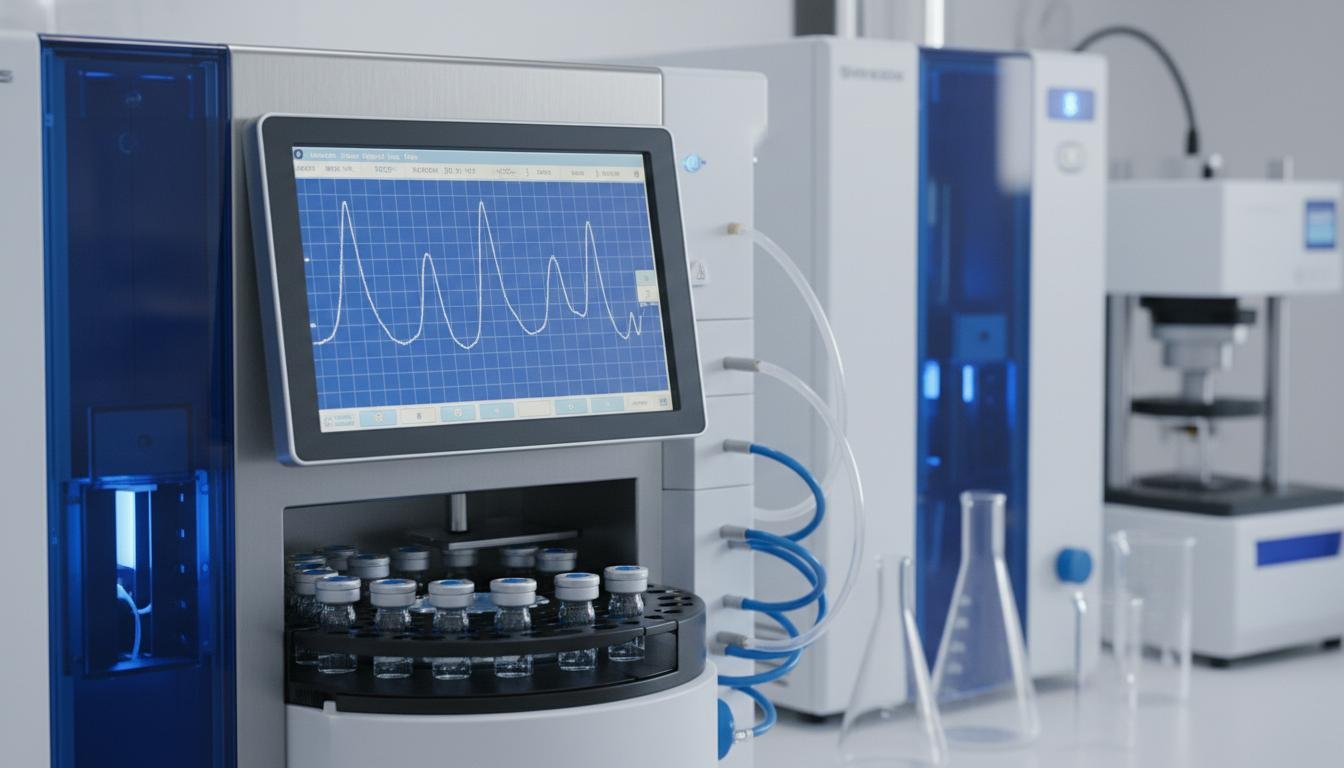
When you view our Certificates of Analysis, the HPLC chromatogram is a key document. Here’s how to read it:
Retention Time
The x-axis shows retention time (minutes). The main peptide peak should appear at a characteristic retention time consistent with its hydrophobicity. Earlier peaks represent more hydrophilic impurities; later peaks indicate more hydrophobic contaminants.
Peak Area and Purity Percentage
Purity is calculated by dividing the area of the main peptide peak by the total area of all detected peaks, then multiplying by 100. AREA 15 LABS guarantees ≥99% purity on all research peptides. Any supplier offering significantly lower purity should be carefully evaluated for research applications.
Peak Shape
A pure, well-behaved peptide produces a symmetrical peak. Tailing (asymmetric trailing edge) can indicate degradation, oxidation, or interaction with the column. Fronting (leading edge distortion) may suggest overloading or solubility issues.
Why Purity Matters in Research Applications
Using low-purity peptides in laboratory research can produce misleading or irreproducible results. A comprehensive review in Analytical Biochemistry highlighted that impurities at levels as low as 1% can significantly interfere with:
- In vitro assays: Contaminating peptides may bind to receptors or enzymes, producing false signals.
- Cell culture studies: Synthesis byproducts can exhibit cytotoxicity unrelated to the target peptide.
- Mass spectrometry analysis: Impurities complicate spectral interpretation and data analysis.
- Structural studies: Deletion sequences and truncated forms can disrupt crystallization and NMR analysis.
This is why AREA 15 LABS invests in comprehensive HPLC testing for every batch of research peptides we sell online. Our third-party verified COAs give researchers confidence in their experimental results.
Complementary Analytical Methods
While HPLC measures purity, other analytical techniques provide additional quality data:
| Method | What It Measures | Why It Matters |
|---|---|---|
| Mass Spectrometry (MS) | Molecular weight and identity | Confirms correct peptide sequence and mass |
| LC-MS/MS | Sequence confirmation | Verifies amino acid order |
| Amino Acid Analysis | Composition ratios | Confirms expected amino acid content |
| Elemental Analysis | C, H, N, O, S content | Confirms molecular formula |
Related Reading
Need Research Peptides and Reconstitution Supplies?
AREA 15 LABS supplies HPLC-tested, USA-made research peptides with verified Certificates of Analysis. Same-day dispatch from our Texas facility.
Looking for Lab-Verified Research Peptides?
AREA 15 LABS supplies HPLC-tested, USA-made research peptides with verified Certificates of Analysis. Same-day dispatch from our Texas facility.